CardapsInsightsFree VIN Decoder Canada — What Every Character Means
VIN & HistoryMarch 18, 20267 min read
Free VIN Decoder Canada — What Every Character Means
Cardaps Research Team
Every vehicle sold in North America since 1981 has a unique 17-character VIN
Quick Answer
A VIN (Vehicle Identification Number) is a unique 17-character code assigned to every vehicle manufactured since 1981. It encodes the country of origin, manufacturer, vehicle type, engine, model year, assembly plant, and a unique serial number. The free CARDAPS VIN Decoder uses the NHTSA vPIC database to decode any North American VIN instantly — no signup required.
A VIN (Vehicle Identification Number) is a unique 17-character alphanumeric code assigned to every vehicle manufactured since 1981. No two vehicles in the world share the same VIN — it's essentially a vehicle's fingerprint.
For Canadian car buyers, the VIN is your first line of defense against fraud. It lets you verify that the vehicle you're looking at matches what the seller claims it is. A VIN decode reveals the exact make, model, year, engine, transmission, body type, manufacturing country, and assembly plant — all from 17 characters.
More importantly, the VIN is the key to unlocking safety and history information. When you enter a VIN into the CARDAPS Recall Check, we can tell you if that specific vehicle has outstanding safety recalls. When you enter it into the CARDAPS Vehicle History tool, we can check CPIC (stolen vehicle database), IBC (flood/fire damage), and RDPRM (Quebec liens).
The VIN is located in three places on every vehicle: on the driver's side dashboard (visible through the windshield), on a sticker inside the driver's door jamb, and on the vehicle's registration document. Always verify that all three locations show the same VIN — a mismatch is a major red flag for VIN cloning or tampering.
What Each VIN Character Means — Complete Breakdown
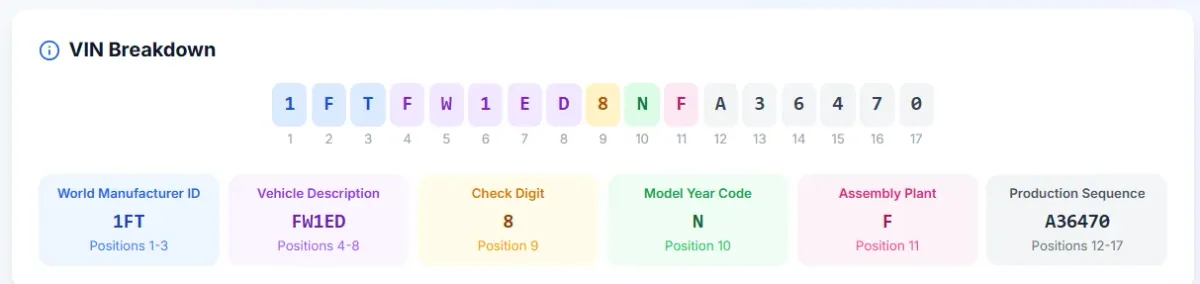
Every VIN follows a standardized format defined by ISO 3779. Here's what each section encodes:
Characters 1–3: World Manufacturer Identifier (WMI). The first character indicates the country of manufacture (1 or 4 = USA, 2 = Canada, 3 = Mexico, J = Japan, K = South Korea, W = Germany). Characters 2–3 identify the manufacturer (e.g., "1G" = General Motors USA, "2T" = Toyota Canada, "JH" = Honda Japan).
Characters 4–8: Vehicle Descriptor Section (VDS). These encode the vehicle's specifications — model, body type, engine, transmission, and restraint system. The exact meaning varies by manufacturer, which is why a VIN decoder database (like NHTSA vPIC) is needed to interpret them.
Character 9: Check Digit. A mathematical verification digit calculated from the other 16 characters using a specific formula. This catches typos and VIN tampering — if someone changes any character, the check digit won't validate.
Character 10: Model Year. Uses a rotating code: A = 2010, B = 2011, ... N = 2022, P = 2023, R = 2024, S = 2025, T = 2026. Note: I, O, Q, U, Z are never used (to avoid confusion with numbers).
Character 11: Assembly Plant. Identifies the specific factory where the vehicle was built. For example, "A" might be an Ontario plant for one manufacturer but a Michigan plant for another.
Characters 12–17: Vehicle Identifier Section (VIS). A unique serial number for that specific vehicle within its model year and plant. This is what makes each VIN truly unique.
CARDAPS VIN Decoder — powered by the NHTSA vPIC government database
The easiest way to decode any VIN in Canada is with the free CARDAPS VIN Decoder. Here's how:
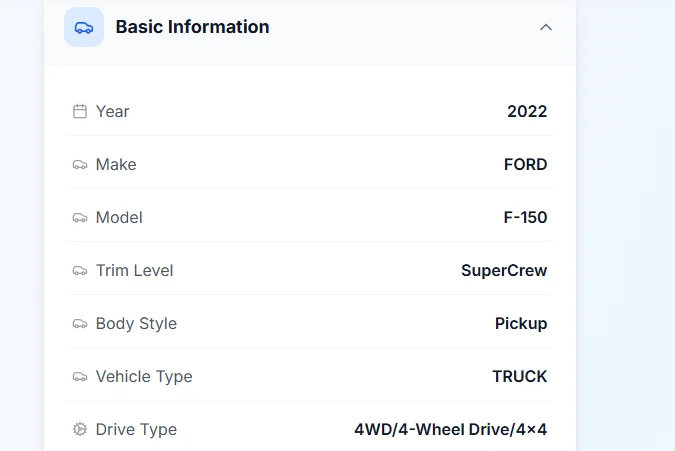
Go to cardaps.ca/vin-decoder. Paste or type your 17-character VIN into the search field. Click "Decode VIN." Within seconds, you'll see the complete vehicle identity: year, make, model, trim, engine displacement and cylinder count, transmission type, drivetrain (AWD/FWD/RWD/4WD), body type, fuel type, manufacturing country (with flag), and number of doors.
The CARDAPS VIN Decoder is powered by the NHTSA vPIC (Vehicle Product Information Catalog) — the same government database that manufacturers use to register vehicle specifications. This means the data is authoritative, not estimated.
After decoding, CARDAPS also gives you one-click access to related tools — all pre-filled with your VIN: Recall Check (are there safety recalls?), Price Estimator (what's the vehicle worth?), Fuel Economy (what are the NRCan L/100km ratings?), and Vehicle History (accident reports, lien status, stolen check).
This makes the VIN Decoder the ideal starting point for any used vehicle investigation. Decode first, then check safety, then check value — all free, all from one platform.
Yes, 100% free with no signup required. The CARDAPS VIN Decoder uses the NHTSA vPIC government database and is free for unlimited use. Decode as many VINs as you need.
Your VIN is in three locations: on the driver's side dashboard (visible through the windshield), on a sticker inside the driver's door jamb, and on your vehicle registration document. All three should match — a mismatch is a red flag.
A VIN decode alone shows specifications, not history. However, you can use the same VIN with the CARDAPS Vehicle History tool to check for accident records, CPIC stolen status, IBC flood/fire damage, and Quebec RDPRM liens — the basic checks are free.
Free Weekly Newsletter
The CARDAPS Market Digest
Canadian used car prices, recall alerts, and market intelligence — delivered weekly. No spam, unsubscribe anytime.
✓Weekly price trends by province and model
✓New recall alerts before they make the news
✓Dealer intelligence: what's hot, what's not
🔒 No spam. Your data is never sold. CASL & Law 25 compliant.
We use cookies to operate Cardaps. Essential cookies are required for the Platform to work. With your consent, we also use analytics (Google Analytics 4) to improve the Platform and, on the free tier, advertising cookies (Google AdSense, Meta Pixel, Google Ads) to support the service.